

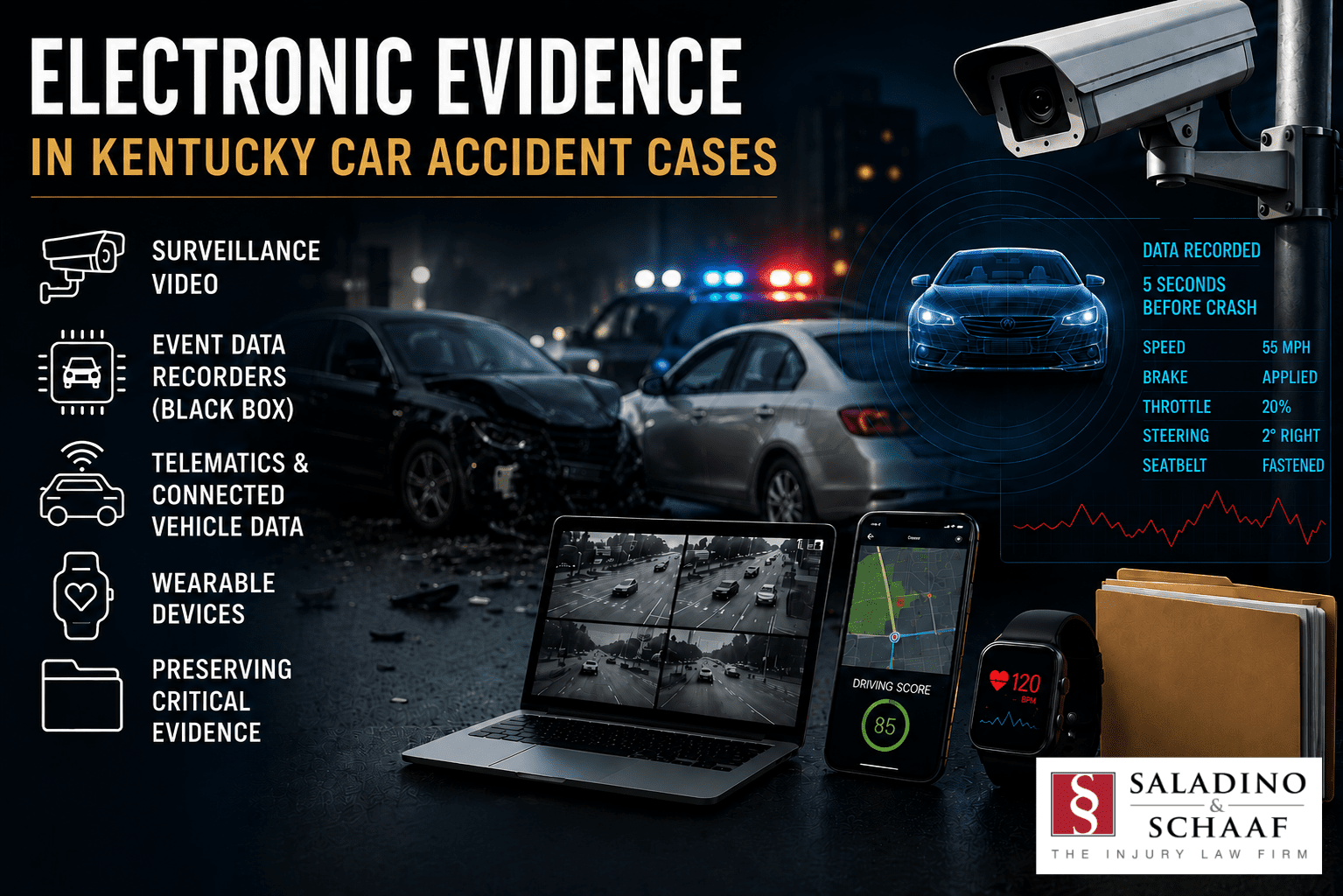
Electronic evidence plays an increasingly important role in Kentucky car accident cases. While medical records, witness statements, and police reports remain important sources of information, modern vehicles and digital devices often provide additional evidence that can help establish how a crash occurred and who was responsible.
From surveillance cameras and vehicle data recorders to wearable devices and connected vehicle systems, electronic evidence can provide objective insight into the circumstances surrounding a collision. Understanding how this evidence is preserved and used can make a difference in the outcome of a car accident case.
Surveillance Video Footage
Surveillance footage is often some of the most compelling forms of evidence in a car accident case. Security cameras, traffic cameras, dash cams, and nearby business surveillance systems may capture the moments leading up to a collision or the crash itself.
Unlike witness testimony, which can be affected by memory lapses or differing perceptions, video footage provides a visual record of events. This evidence can help establish vehicle positions, traffic conditions, signal status, and driver behavior immediately before impact.
Although highly persuasive, surveillance footage is not automatically admissible in court. Like all evidence, it must be properly authenticated. Attorneys often rely on maintenance records, system logs, and testimony from the camera owner or operator to establish that the equipment was functioning properly and accurately recorded the events in question.
When available, surveillance footage can help strengthen a claim by providing a clear and compelling account of how the collision occurred.
Photographs taken immediately after a crash can also be valuable evidence. Learn more about how photos from the accident scene can strengthen your claim.
Event Data Recorders
Many modern vehicles contain Event Data Recorders (EDRs), which are often referred to as a vehicle’s “black box.” These devices record certain operational data in the moments immediately before and during a crash.
Depending on the vehicle, an EDR may record information such as:
- Vehicle speed
- Engine RPM
- Brake application
- Steering input
- Seatbelt usage
Individually, these data points may not tell the whole story but, when analyzed together, they can help reconstruct the sequence of events leading up to a collision and provide valuable insight into the driver’s actions.
Event Data Recorder information is often particularly important when drivers offer conflicting accounts of how a crash occurred.
Because vehicles involved in serious crashes are often repaired, salvaged, or destroyed relatively quickly, preserving EDR data requires prompt action Once a vehicle is altered or disposed of before the data is preserved, critical evidence may be lost forever.
The attorneys at Saladino & Schaaf, PLLC can move quickly to preserve electronic evidence before it becomes unavailable. In many cases, preservation letters and formal legal requests are necessary to ensure important evidence remains available.
Preserving Electronic Evidence
When it comes to electronic evidence, timing is critical in any Kentucky car accident case.
Valuable information may exist in vehicles, surveillance systems, cell phones, wearable devices, or third-party databases. Unfortunately, some of this data can be overwritten, deleted, or lost if prompt steps are not taken to preserve it.
To help safeguard important evidence, attorneys often send preservation or spoliation letters shortly after a collision. These letters place individuals, businesses and other entities on notice that relevant evidence must be retained for future investigation and litigation.
Preservation efforts may include securing vehicle data, surveillance footage, maintenance records, dispatch records, cell phone data, and other electronic information that could impact liability or damages.
The sooner an investigation begins, the greater the likelihood that important electronic evidence can be identified and preserved.
Telematics and Wearable Technology
Another growing category of electronic evidence involves telematics systems and wearable devices.
Telematics systems collect and transmit information about vehicle operation, including location, speed, acceleration, braking activity, and crash notifications. Connected vehicle services such as OnStar and similar technologies may preserve valuable information about a collision and the events leading up to it.
Wearable devices such as smartwatches and fitness trackers can also provide useful information. Depending on the device, available data may include activity levels, heart rate measurements, movement patterns, and timestamps.
In some cases, this information can help demonstrate how an injury has affected a person’s daily activities following a crash. Wearable device data may also support medical evidence by documenting changes in activity levels before and after an accident.
Likewise, telematics data can help confirm or challenge competing accounts of how a collision occurred, making it an increasingly valuable tool in modern car accident investigations and litigation.
Why Electronic Evidence Matters
Electronic evidence often helps fill gaps that traditional forms of evidence cannot. Understanding how evidence fits into the overall legal process is equally important. Read our guide to the timeline of an accident lawsuit in Kentucky from filing to settlement to learn what happens after an accident claim is filed.
When combined with more traditional forms of evidence, electronic records can strengthen liability arguments and help establish the full extent of a victim’s damages.
As vehicles and technology continue to evolve, electronic evidence will likely play an even larger role in Kentucky car accident claims.
Count on the Kentucky Personal Injury Lawyers at Saladino & Schaaf, PLLC
Proper identification and preservation of electronic evidence can strengthen a car accident claim. The attorneys at Saladino & Schaaf can determine what electronic evidence may exist and help to take steps to preserve important information before it is lost or destroyed.
To schedule your free consultation, call (270) 444-0406 (Paducah) or (270) 753-1529 (Murray) or contact us online. The sooner you reach out, the sooner your case can be properly evaluated. Our offices are conveniently located in Paducah and Murray.