

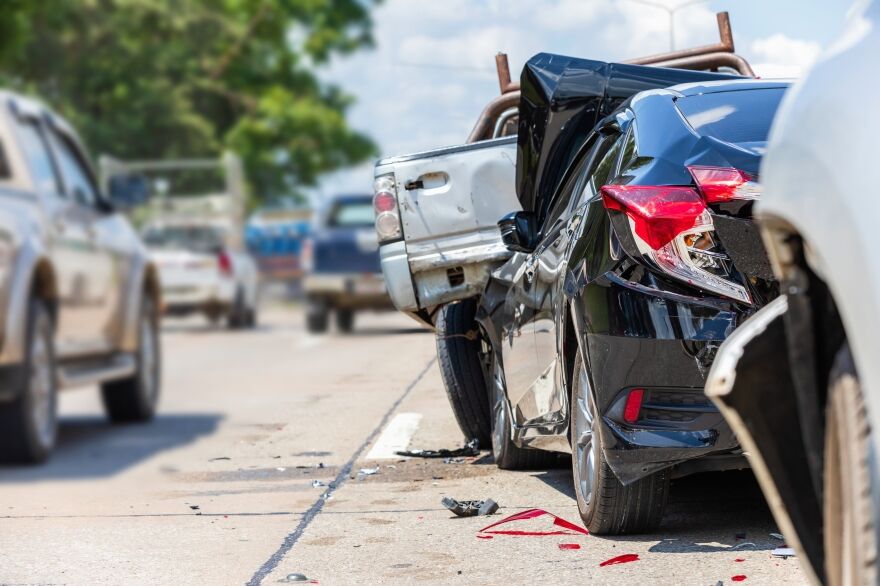
Multi-vehicle truck accidents in Kentucky often involve multiple potentially responsible parties. In these cases, an employer may be liable for its driver’s negligence under the doctrine of respondeat superior while Kentucky’s pure comparative fault rule governs how fault is apportioned between all involved parties. (The comparative fault statute, KRS 411.182, requires damages to be reduced in proportion to each party’s percentage of fault.) When more than two vehicles collide, liability issues multiply. For example, in a chain-reaction collision, the first vehicle to initiate contact may share fault with both the negligent truck driver and any intervening motorists. An experienced Paducah truck accident lawyer knows that thorough investigation is essential in these cases – even a jury verdict attributing fault to the injured party still allows recovery under Kentucky’s comparative fault system.
Kentucky law also distinguishes between the preliminary fault determination and the legal liability decision. Initial conclusions at the scene can change as additional evidence becomes available, including witness statements, expert analysis, or data retrieved from the truck’s black box data (EDR – “event data recorder”). While Kentucky’s vehicle data privacy laws (KRS Chapter 610) can present challenges in obtaining EDR/ELD data such information can be critical in establishing speed, brake patterns, and hours driven.
In many instances, multi-vehicle truck accidents may give rise to employer liability. Under respondeat superior, the truck’s owner (often the employer) may be held vicariously liable for its driver’s negligence committed within the scope of employment. Moreover, Kentucky law allows separate claims against the employer for negligent hiring or supervision. In MV Transp., Inc. v. Allgeier, the Kentucky Supreme Court confirmed that an employer is “responsible for a worker’s negligent acts” and may also be sued for negligent entrustment, supervision, or training. This means the trucking company can face liability for both its driver’s mistakes and any independent wrongdoing in preparing or overseeing that driver.
Comparative Fault in Kentucky
Kentucky follows a pure comparative fault system. Under KRS 411.182, the jury assigns a percentage of fault to each party, and any damages awarded are reduced in proportion to that allocation. For example, if a truck driver and another motorist share fault in a chain-reaction crash, each would pay only their portion of the damages. There is no all-or-nothing bar to recovery. Even if a victim is 90% at fault, they can still recover 10% of their damages. For instance, in a rear-end collision on a wet highway where the injured driver was only slightly tailgating, a jury might assign 80% fault to the trucker and 20% to the injured driver. The injured driver’s recovery would then be reduced by their 20% share.
Because fault allocation can impact recovery, it is critical to gather evidence that maximizes the truck driver’s responsibility. Accident reconstruction diagrams, EDR readings, toxicology results, and witness statements may all play a role in shaping the comparative fault assessment.
Other Vehicles and Contributing Parties
Chain-reaction crashes often involve multiple vehicles, not just a truck and one car. For example, a sudden stop in traffic can leave following drivers with insufficient time to react, triggering a series of rear-end collisions involving several vehicles, including a truck. In these situations, more than one driver may share responsibility depending on how each vehicle was operated.
When a vehicle is involved in a multi-car pile-up, every driver’s actions must be carefully evaluated. In some cases, a driver who initially lost control, perhaps due to a tire blowout or mechanical issue, may still be partially liable if negligence, such as poor maintenance, contributed to the crash.
Contributory factors may include:
- Unsafe lane changes or failures to signal
- Poor vehicle maintenance (e.g. bald tires or worn brakes on any of the vehicles involved)
- Debris or hazards on the road that one vehicle negligently left behind
- Contractors or third parties: For example, a mechanic who improperly repaired brakes on the truck could be liable if their negligence caused or contributed to the crash.
“Joint and Several” vs. “Several” Liability
Kentucky follows a pure several liability system, rather than joint-and-several. This means each defendant pays only their share of fault. KRS 411.182(3) explicitly directs the court to assign “each party’s equitable share of the obligation” according to fault percentages. If one defendant cannot pay their share, the uncompensated portion is not shifted to the others.
For example, imagine a truck collision caused by both a drowsy truck driver and a negligently maintained tire by an independent shop. If a jury allocates 60% fault to the truck driver’s negligence and 40% to the shop’s poor maintenance, each is liable for their percentage. If the shop is bankrupt, the victim can only recover 60% of damages (from the truck driver and employer).
Working with a Truck Accident Attorney
Complex multi-vehicle crashes demand a specialized approach. An experienced Kentucky truck accident lawyer may:
- Preserve evidence: Secure the truck’s EDR/ELD data, maintenance records, and any available surveillance video.
- Analyze driver logs: Examine drivers’ hours-of-service logs (ELDs) for potential violations of Kentucky’s fatigue laws. Fatigued driving may be treated similar to impaired driving under the law.
- Interview witnesses: Gather statements from all drivers and passengers to help clarify the sequence of events.
- Consult experts: Work with accident reconstruction specialists to analyze chain-reaction scenarios and calculate speeds or reaction times.
Even if an initial investigation suggests you may be at fault, that doesn’t mean you should give up. Under Kentucky’s comparative fault law, you may still be able to recover against the truck driver and other negligent drivers. The attorneys at Saladino & Schaaf, PLLC focus on maximizing your recovery. By clearly presenting each party’s percentage of fault to the jury, we work to ensure that you are only assigned your share of responsibility.
Call for a Consultation. We’re Here to Help
Count on the experienced Kentucky personal injury lawyers at Saladino & Schaaf to navigate the complexities of multi-vehicle truck collisions. To schedule a free consultation, call us today at (270) 444-0406 (Paducah) or (270) 753-1529 (Murray). We routinely handle cases throughout Kentucky. Our offices are conveniently located in Paducah and Murray.